

Finding swim schools with waitlists: building a map of underserved regions
If you are expanding a swim school franchise, one question matters more than any other: where is demand so high that existing providers cannot keep up? A very direct signal is often right there on the swim schools' own websites: "All classes fully booked," "Registration via waitlist only," "No new enrollments until fall." This article shows how Haystack captures every swim school in Germany, reads those signals, and turns them into a reliable shortlist of locations for you.
Request data
The problem: everyone knows demand is high, nobody knows where
The shortage of swim lesson spots is not news. According to a 2022 Forsa survey commissioned by the DLRG, the German Life Saving Association, about one in five elementary school children in Germany cannot swim, up from about one in ten in 2017. In its statement to the German Bundestag, the DLRG also reports that about half of its local chapters offering beginner classes keep waitlists, and that children wait about six months on average for a spot. Only 13 percent of children learned to swim at school, according to the parents surveyed.
Swimming ability and waitlists by the numbers
Forsa survey commissioned by the DLRG, 2022. In 2017 it was about one in ten.
DLRG statement to the German Bundestag (2025).
According to the DLRG statement to the Bundestag, children wait about half a year on average.
Forsa survey commissioned by the DLRG, 2022.
For expansion planning, though, a national figure does not help much. You need demand by region: Is the bottleneck worse in the Munich suburbs than in Leipzig? Are there any private providers in county X at all, or just one club with two lane slots a week?
Why this list is nearly impossible to build by hand
- No central directory. Swim lessons are offered by private swim schools, clubs, DLRG and Wasserwacht chapters, municipal pools, hotels with pools, and mobile instructors without a pool of their own. No database covers them all.
- Capacity status is never structured. "Waitlist" might be on the homepage, in a PDF class schedule, or buried in a booking tool. Sometimes it just says "We are not accepting new registrations at this time."
- The status goes stale fast. Classes are reassigned every six months, so any snapshot is outdated within a few months.
- List brokers don't offer this attribute. You can buy addresses with an industry code, but not "fully booked since March."
Doing it by hand, figure roughly 3 to 5 minutes per provider: open the website, find the classes page, read the status, write it down. With several thousand results, that quickly adds up to several person-weeks, and by the time you finish, half the data is already outdated.
Manual research, list broker, or Haystack
The differences, as laid out in the sections above and below.
| Manual research | List broker | Haystack | |
|---|---|---|---|
| Capacity status (waitlist/fully booked) | Yes, by reading every website | No, only addresses with an industry code | Yes, Haystack reads every website and records the status per provider |
| Effort | Roughly 3 to 5 minutes per provider; several person-weeks for several thousand results | n/a | Runs automatically; you only review the sample and the result |
| Freshness / repeatability | Half outdated by the time you finish | n/a | Rerun the analysis in six months with the same search area and compare |
How Haystack helps
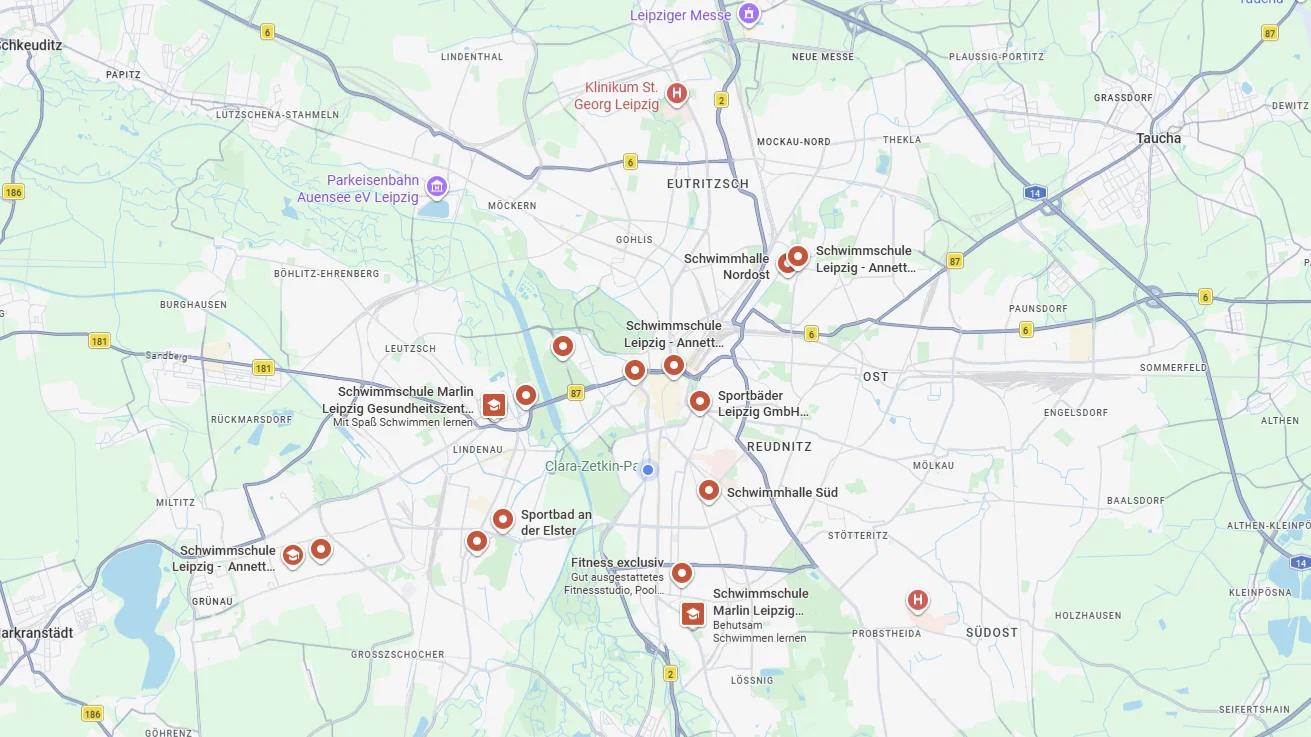
Haystack collects all providers through a nationwide Google Maps search, opens every website the way a researcher would, and answers the same questions for each business: Is this really a swim lesson provider? Is there a waitlist or are classes fully booked? Who runs the school? The result is a list with address, postal code, and capacity signal that you can analyze by region or load into a mapping tool.
The real advantage is repeatability: with the same search area, the analysis runs again in six months, and you see where the situation has gotten worse.
We use the same principle, reading publicly visible bottleneck or gap signals from websites, for physical therapy practices in Berlin without online booking and for Fort Worth warehouses hiring forklift operators.
For an overview of all examples, see AI-built lead lists: real-world examples.
How Haystack finds the data
- 01
Collect every provider
Haystack searches Google Maps for terms such as Schwimmschule, Schwimmkurs Kinder, Seepferdchen Kurs, Babyschwimmen, Schwimmverein, and DLRG Ortsgruppe. The search runs over a grid covering all of Germany, denser in metro areas, because Google Maps returns only a limited number of results per search point. For each business you then have name, address, phone, website, Google category, and reviews.
- 02
Filter out cheaply first
Based on name and category, hotels, outdoor pools without lessons, sporting goods stores, and pool builders are removed. This costs almost nothing and ensures the expensive research only happens for genuine lesson providers.
- 03
Then research in depth
For the remaining providers, Haystack opens the website and finds the page with classes and registration. That is where it says whether there is a waitlist, whether classes are full, and which class types are offered. Using the legal notice (Impressum), Haystack checks whether a private operator, a club, or a municipality runs the school.
- 04
Test run and spot check
Before all results are analyzed, the process runs on 50 to 100 providers. We check 10 to 20 waitlist entries against the website by hand. Only when the classification is right does the full run start. That way you don't pay for a list with systematic errors.
- 05
Deliver the result
You receive the list as a password-protected link for your expansion team and as an Excel file for your GIS or mapping tool.
The stages at a glance
| Stage | What happens | Why |
|---|---|---|
| 1. Identify lesson providers | Haystack checks name and Google category and removes hotels, outdoor pools without lessons, sporting goods stores, and pool builders | Costs almost nothing and saves the expensive research for real providers |
| 2. Find the class page | Haystack opens the website and follows the navigation to the page with classes and registration | Capacity status is almost never on the homepage but on subpages such as "Classes" or "Registration" |
| 3. Read capacity | Haystack reads whether a waitlist is kept, classes are fully booked, spots are available, or nothing is stated | This is the actual demand signal, and fixed categories make the list filterable |
| 3. Capture class offering | Haystack notes which classes are offered, such as Seepferdchen (beginner) or baby swimming | Shows exactly where the bottleneck is |
| 3. Classify the operator | Haystack checks the legal notice to see whether a private operator, a club, or a municipality runs the school | A waitlist at a volunteer-run club means something different than one at a private competitor |
| 4. Capture evidence | Only for waitlists or full bookings, Haystack quotes the relevant sentence, including the waiting time if stated | You can verify every classification yourself later |
| 5. Score demand | Status, waiting time, class offering, and number of Google reviews produce a score from 0 to 10 | The list can be sorted by urgency |
What you end up with
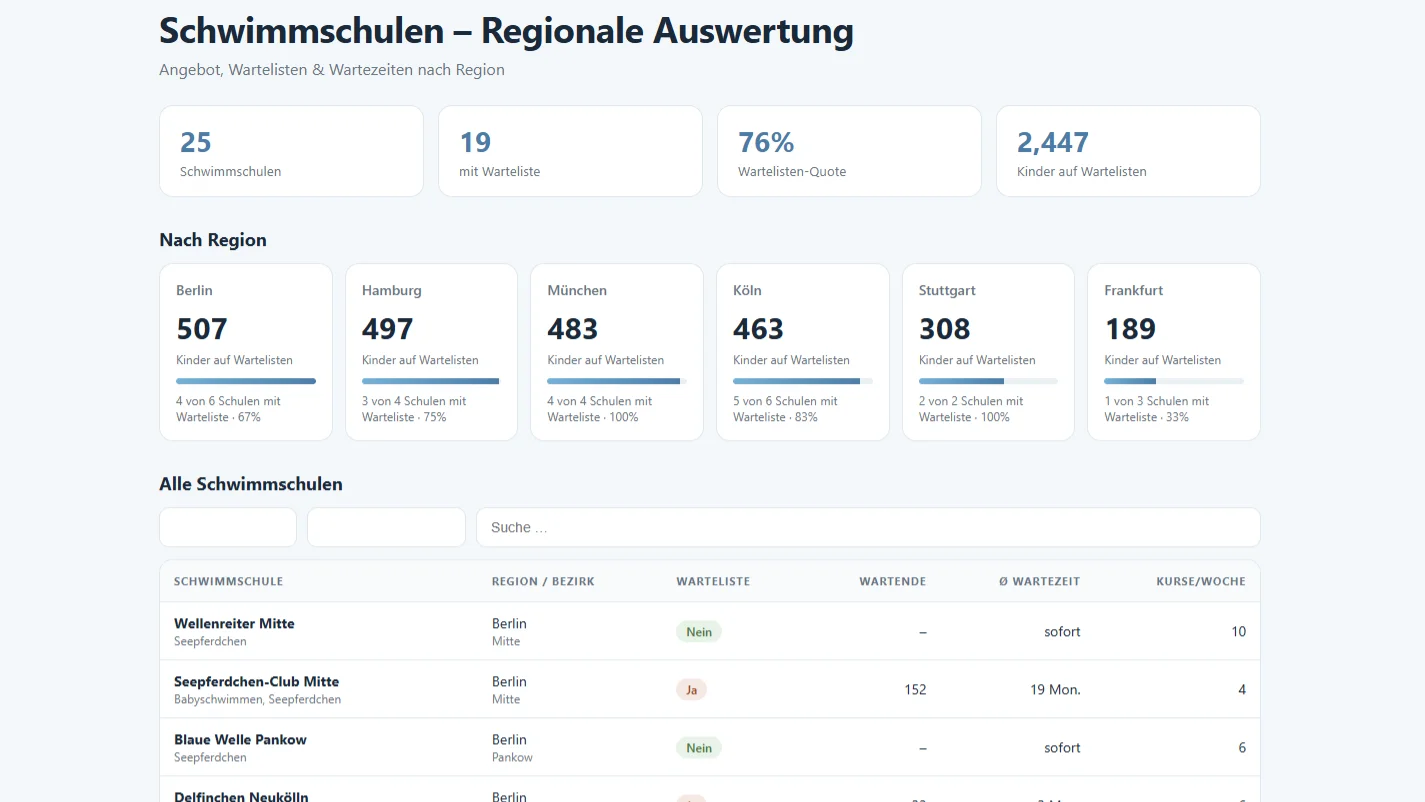
A list of all genuine swim lesson providers with name, address, postal code, city, website, operator type, capacity status, class offering, quoted evidence, and demand score, sorted by strongest demand. Chains with several pools can be grouped. Optionally, a second tab shows every business checked, with the reason it was filtered out.
You receive the list as a password-protected link and as an Excel file. Load the Excel file with postal code and score into your GIS or mapping tool and aggregate by county or postal code area. That gives you the map: regions with many waitlists, few private providers, and high population density are candidates for new locations. Haystack does not generate the map itself.
Quality assurance
The test run on a sample shows early where things get stuck. If classes are often hosted on external booking platforms, the search is extended to cover them. If the status is frequently unclear, Haystack adds more typical phrasings, such as "Kurse für 2027 bereits vergeben" (classes for 2027 already assigned). The result: fewer gaps and a list your team can trust. The proven approach can later be applied to dance or music schools.
Honest limitations
- Snapshot. The status reflects the day of the analysis. Account for seasonal effects (right before summer break, almost everything is full) when interpreting results, and ideally rerun the analysis.
- Missing information is not proof of availability. Many clubs don't post their waitlist on the website and manage it by email instead. So "unclear" does not mean "spots available."
- Missing websites. Providers with no website, or only a social media profile, deliver no capacity signal.
- Google Maps coverage. Mobile swim instructors without a Maps listing are missing from the raw data.
- Pool space. This analysis does not tell you whether a rentable pool exists in a region for a new location. That remains a separate check.
- Not statistics in the strict sense. The analysis shows signals per provider, not a representative measurement of demand.
Data privacy
The data collected is publicly available business information: company name, business address, website, and publicly posted class information. Personal data is not needed for this use case, so leave out columns such as contact person. If an owner is a sole proprietor, the business name itself can count as personal data under the GDPR. In that case, document the purpose (site selection), the legal basis (legitimate interest under Art. 6(1)(f) GDPR), and a retention period. If you later want to use the list for outreach or acquisition talks (our example of skilled trade businesses in Halle and Bernburg shows how to find succession candidates systematically), German unfair competition law (UWG) also applies to any contact, especially marketing emails and calls. When in doubt, check with your data protection officer.
More real-world examples
Berlin Physical Therapy Practices Without Online Booking: A Lead List for AI Phone Assistants
How a lead list of Berlin physical therapy practices with 5+ therapists that only take appointments by phone is built: what Haystack checks and why.
Moving Companies in NRW Without Google Ads: Lead List with Owner and Direct Line
How a Google Ads agency builds a list of every moving company in NRW with 100+ reviews, no ads, plus owner and direct line from the Impressum.
FAQ
How many swim schools does the search find in Germany?
That depends on the search area and the search terms. In our experience, including clubs and pools, you end up with several thousand results, a meaningful share of which the first stage filters out. Only a test run for your area gives you a reliable number.
Can Haystack detect waitlists in PDF schedules or booking tools?
Haystack reads linked pages and publicly accessible booking pages. Content behind a login cannot be reached. These providers are marked as unclear, so you can see where information is missing.
Can I analyze only certain states?
Yes. The search area can be limited to a single state or a radius around planned locations.
How often should I rerun the analysis?
Classes are usually assigned every six months. One run per half-year with the same search area makes trends visible.
Does Haystack produce the map directly?
No. Haystack delivers the verified list with addresses and scores as a password-protected link and an Excel file. You do the visualization in your mapping tool.
Can this approach be applied to other industries?
Yes, anywhere providers publicly communicate capacity bottlenecks, such as daycare centers, music schools, physical therapy practices, or dog training schools. Usually only the search terms and the questions asked of the websites change.
Sources
- DLRG, press release on the 2022 Forsa survey (PDF, German) — DLRG, 2022
- DLRG, fact check "Challenges for the future" (PDF, German) — DLRG
- DLRG, statement to the German Bundestag, January 2025 (PDF, German) — Deutscher Bundestag, 2025
Next step
Planning new locations and want to know where families are already stuck on waitlists? Get in touch. We will start with a test run for a region of your choice.
Request data