

How to Find Every IT Staffing Agency in Central NJ With Open C2C Java or SAP Roles (and the Owner's LinkedIn)
A New Jersey IT consulting firm with a bench of Java and SAP consultants faces one recurring question: which staffing agencies near us need our people right now, on corp-to-corp (C2C) terms, and who makes the decision there? This article explains why that list is hard to build by hand, what Haystack checks at each stage and why, and what you end up with.
Request data
The problem: a dense market where nobody publishes a clean list
Central New Jersey, roughly the Edison, Iselin, Piscataway, Princeton, Plainsboro and New Brunswick corridor, has one of the densest concentrations of IT consulting and staffing firms in the US. Public H-1B data gives a sense of the scale: the USCIS H-1B Employer Data Hub can be filtered by city and lists petitioning employers for fiscal years 2009 through 2026, and the Department of Labor publishes every Labor Condition Application in its LCA disclosure data. One aggregator built on this data counts 49 employers with approved H-1B petitions at Edison addresses alone. Many of these are small vendors with 5 to 50 people that live on C2C requirements.
The scale of the Central NJ vendor market
Source: USCIS, H-1B Employer Data Hub (primary source).
Source: F1Jobs, "H-1B sponsors in Edison, NJ" (based on public petition data).
Many are small vendors that live on C2C requirements.
For a consulting firm that wants to place consultants with these vendors, a generic list of "staffing agencies in NJ" is worth very little. The useful list has three filters:
- Located in Central NJ: local vendors are easier to meet, and they often subcontract to each other.
- Has an open contract role for Java or SAP right now, and that role is open to C2C rather than W2 only.
- Has a named owner or managing director with a public LinkedIn profile, because at small vendors the owner usually makes the vendor decision.
Why building it manually is slow
- Job boards are noisy. A search for "Java C2C Edison" on Dice returns a long list of postings, many of them reposts of the same end-client requirement by different vendors. Matching postings back to a company, deduplicating them and checking the location takes hours.
- C2C status is buried. "C2C OK", "No C2C" or "W2 only" usually appears somewhere in the job text, not in a structured field.
- Owners are not in standard databases. Listbrokers cover the large staffing brands well. A 12-person LLC in Iselin often shows up with no contact, or with a recruiter who left two years ago.
- The data goes stale fast. Contract requirements open and close within days or weeks, so a list bought last quarter is mostly wrong about who is hiring today.
Doing this for about 300 to 500 candidate companies easily costs a researcher one to two weeks, and the result is out of date by the time it is finished.
How Haystack helps
Haystack does not sell a database. It searches the market fresh for each project and has an AI read each company's own website, career page and public search results. The result covers small vendors too, is current as of the run, and is backed by sources.
A typical project of this size, from setup and test run to the finished share link, takes a few days rather than weeks of manual research. The exact time depends on the number of companies in the grid and how many refinements the test run shows.
The same pattern, a fresh market scan plus a live hiring or website signal, works in very different markets: see how we find Fort Worth warehouses that are hiring forklift operators or Toronto fashion brands on Shopify that offer free returns.
For an overview of all examples, see AI-built lead lists: real-world examples.
Where the vendor list comes from
| Manual research | Listbroker | Haystack | |
|---|---|---|---|
| Small vendors and owners | Owners must be researched one by one; job boards are noisy and full of reposts. | Covers the large staffing brands well. A 12-person LLC in Iselin often shows up with no contact, or with a recruiter who left two years ago. | An area-wide Google Maps search finds firms that never show up in listbroker data; the AI looks up owners on the company site and in public search results. |
| Freshness | The result is out of date by the time it is finished. | A list bought last quarter is mostly wrong about who is hiring today. | Open Java or SAP contract roles are checked at the time of the run, with the URL of the posting as evidence. |
| Effort for 300 to 500 companies | One to two weeks of a researcher. | n/a | A few days from setup and test run to the finished password-protected link. |
How Haystack builds the list
Where the search starts
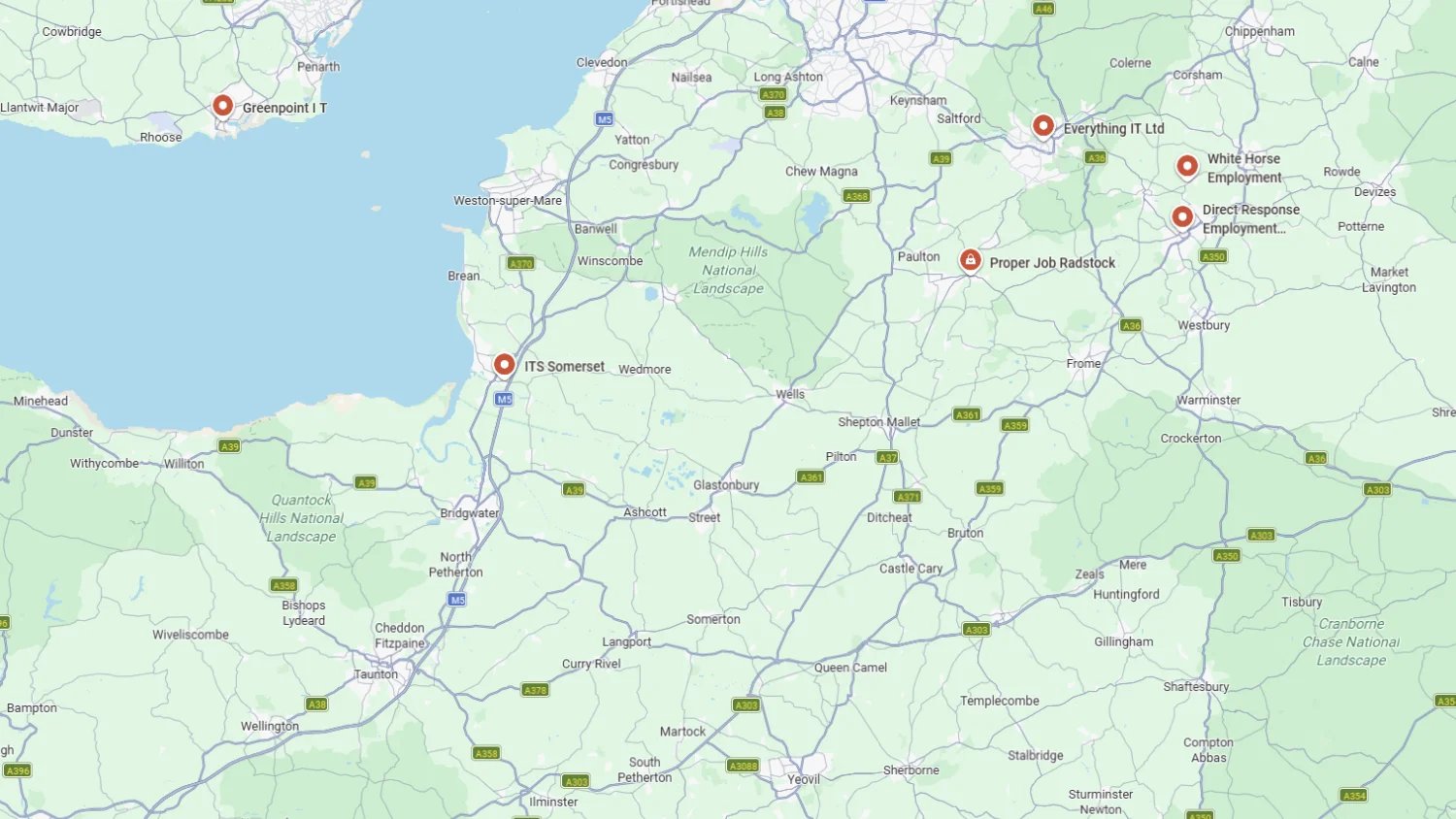
Haystack searches Google Maps for several terms at once that these firms use to describe themselves, such as "IT staffing agency", "IT consulting", "staffing agency", "software consulting", "IT recruiter" and "SAP consulting". The search area covers Middlesex, Somerset and Mercer counties plus the Princeton area of northern Mercer and southern Monmouth.
The area is split into a dense grid of many small search points. The reason: in Edison and Iselin, dozens of firms share the same office parks, and a coarse search only shows the top results per location. Only a dense grid surfaces the small LLC on the third floor as well.
At the end of this step, Haystack has the public Maps listing for every company: name, address, phone, website, category, rating and number of reviews. That is the raw list that the following stages filter and enrich.
The research in stages
| Stage | What happens | Why |
|---|---|---|
| 1. Check for IT staffing | Haystack reads each company's website and checks whether it places IT consultants. General staffing firms (warehouse, nursing), pure software product companies and unrelated businesses are dropped. | This is the cheapest step and removes most of the list before the costly research begins. |
| 2. Find the jobs page | Haystack looks for the page where the company posts open requirements: its careers page, its applicant tracking job board, or listings on Dice and LinkedIn. | Without a jobs page there is no way to check whether a matching role is open right now. |
| 2. Find the owner | Haystack checks the About, Team and Leadership pages and public search results for the founder, CEO, president or managing director. | At small vendors, the owner almost always makes the vendor decision. |
| 3. Check open C2C roles | Haystack reads the current postings and looks for Java or SAP contract roles where C2C is allowed or not ruled out. Postings marked "W2 only" or "No C2C" do not count. | This is the real buying signal: this firm needs consultants you can supply, now. |
| 3. Owner's LinkedIn | Haystack finds the public LinkedIn profile through a normal web search and confirms it against company name and location. No LinkedIn interface is used. | Your sales team can reach the decision maker directly and personally. |
| 4. Prioritize | Haystack scores each qualified firm from 1 to 10 with a short reason, based only on the information already collected. | Your team starts with the most promising vendors instead of going alphabetically. |
These building blocks can be reused for the next staffing project, for example for Northern NJ or the Philadelphia metro area. The owner lookup works the same way for cross-border B2B lists, such as Mexican exporters in Altamira and Tampico that ship to the US.
Test run and spot check
Before all companies are processed, the research runs on a sample of around 30 companies. This shows where it needs sharpening. Typical findings in this use case:
- Jobs page not found: many vendors link their job board only at the very bottom of the site or on a separate subdomain. Haystack then looks there specifically.
- Too generic: a line like "we hire Java developers" without a real posting does not count as an open role. Only an actual posting with a title counts.
- Wrong owner: several firms have similar names, such as "…Tech Solutions LLC". An owner is only accepted if the source clearly ties them to this company at this location.
A person then checks a sample against the sources, and only then does the full research run. For you, that means fewer false hits and no guessed names.
What you receive
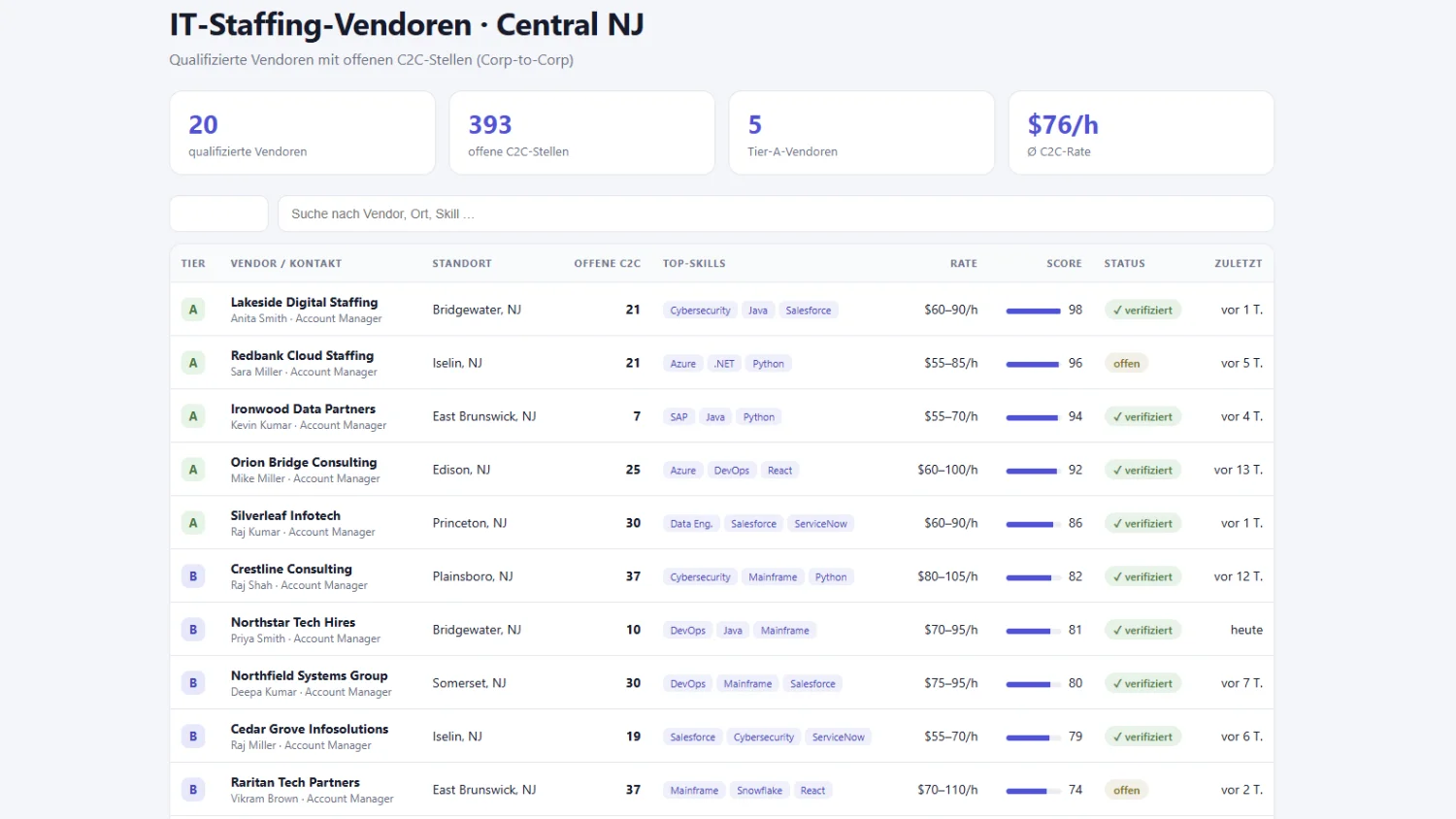
You get a password-protected link to your list and, if you like, the same list as an Excel file. It contains only what you need:
- Only matching firms: Central NJ vendors with at least one open Java or SAP role that allows C2C.
- Per firm: name, address, phone, website, the roles found with a link to each posting, owner with title and LinkedIn profile.
- Priority with a reason: the most promising vendors are at the top.
- Each firm once, even if it has several offices.
- Optionally, every company checked: with status and reason, so you can see why a firm is not on the list (for example "not IT staffing, healthcare staffing").
Every entry is backed by its source, so your sales team can check it before the first call.
Honest limits
- Snapshot, not a feed. Contract roles change weekly. The list reflects the date of the run. For ongoing use, the project must be run again.
- Not every vendor publishes roles. Many requirements are sent only through email lists to the vendor's own network. Haystack cannot see those. If a firm shows no role, that means "no public matching role found", not "never needs Java people".
- C2C wording is interpreted. Where a posting does not mention the employment type, the AI follows a fixed rule. Borderline cases should be checked by a person before outreach.
- LinkedIn matches are based on public search results. Some owners have no public profile, or use a different name on LinkedIn. Those fields stay empty rather than being guessed.
- Google Maps coverage. Virtual-office firms without a Maps listing can be missed. Additional search terms or a second search reduce, but do not remove, this gap.
Data protection and outreach rules
The list contains business information and names of business decision makers from public sources. If you email these contacts, US commercial email falls under the CAN-SPAM Act: no misleading headers or subject lines, a valid physical postal address, and a working opt-out that is honored within 10 business days. LinkedIn messages and connection requests are subject to LinkedIn's own user agreement. Haystack does not send emails or LinkedIn messages; outreach stays with you.
More real-world examples
How to Find Every Toronto Fashion D2C Brand on Shopify With Free Returns (Plus the Founder's LinkedIn)
Build a list of Toronto fashion D2C brands on Shopify with free returns, plus founder LinkedIn profiles. How Haystack checks every brand in five stages.
Fort Worth Warehouses Hiring Forklift Operators: Building a Lead List with Plant Manager Names
How a Texas guardrail maker finds every Fort Worth warehouse and plant with active forklift hiring, plus the plant or facility manager's name.
How to Build a List of Mexican Exporters in Altamira/Tampico Shipping to the US, with Export and Logistics Managers
How a Houston freight forwarder finds every US-bound exporter around Altamira and Tampico, with the export or logistics manager's name. Stage by stage.
FAQ
Which towns count as Central NJ in this project?
We usually cover Middlesex, Somerset and Mercer counties, with Edison, Iselin, Woodbridge, Piscataway, New Brunswick, Princeton, Plainsboro and Somerset as core areas. The grid can be adjusted to your definition.
Can I search for other skills than Java and SAP?
Yes. Only the check for open roles is switched to other skills, for example Salesforce, .NET, data engineering or ServiceNow. All other stages stay the same.
How do you know a role is C2C?
The AI reads the job text and looks for explicit wording such as "C2C", "corp-to-corp" or "W2 only". Roles that rule out C2C are not counted, and the URL of each role is included so you can check it.
Do you use the LinkedIn API or scrape LinkedIn?
No. The owner's profile is found through a web search for public results and confirmed against the company name.
How fresh is the data?
It is as of the date of the run. Because contract roles turn over quickly, many clients repeat the project monthly with the same criteria.
Can I get the data as Excel?
Yes. The Excel file contains the same firms and details as the password-protected link.
Sources
- USCIS, H-1B Employer Data Hub (FY2009 to FY2026, filterable by city, state and ZIP) — USCIS
- US Department of Labor, OFLC performance data (LCA disclosure data) — U.S. Department of Labor
- F1Jobs, "H-1B sponsors in Edison, NJ" (49 employers with approved petitions) — F1Jobs
- Dice, job search "H1B / Edison, NJ" — Dice
- Federal Trade Commission, "CAN-SPAM Act: A Compliance Guide for Business" — Federal Trade Commission
Get your Central NJ vendor list
Do you place Java, SAP or other consultants on C2C contracts and want to know which agencies in your area are hiring right now? Contact Haystack at haystack-group.com. We tailor the search area and criteria to your skills and send you a password-protected link with the qualified vendors and their decision makers.
Request data