

Mexican Exporters in Altamira/Tampico Shipping to the US: Building the Lead List with Haystack
A Houston freight forwarder wants a clear target list: every manufacturer and exporter in the Altamira/Tampico/Ciudad Madero area that ships goods to the United States, together with the name of the person who decides on freight, usually the export manager (gerente de exportaciones, jefe de comercio exterior) or logistics manager (gerente de logística). This article shows how Haystack builds that list stage by stage, what happens in each stage and why.
Request data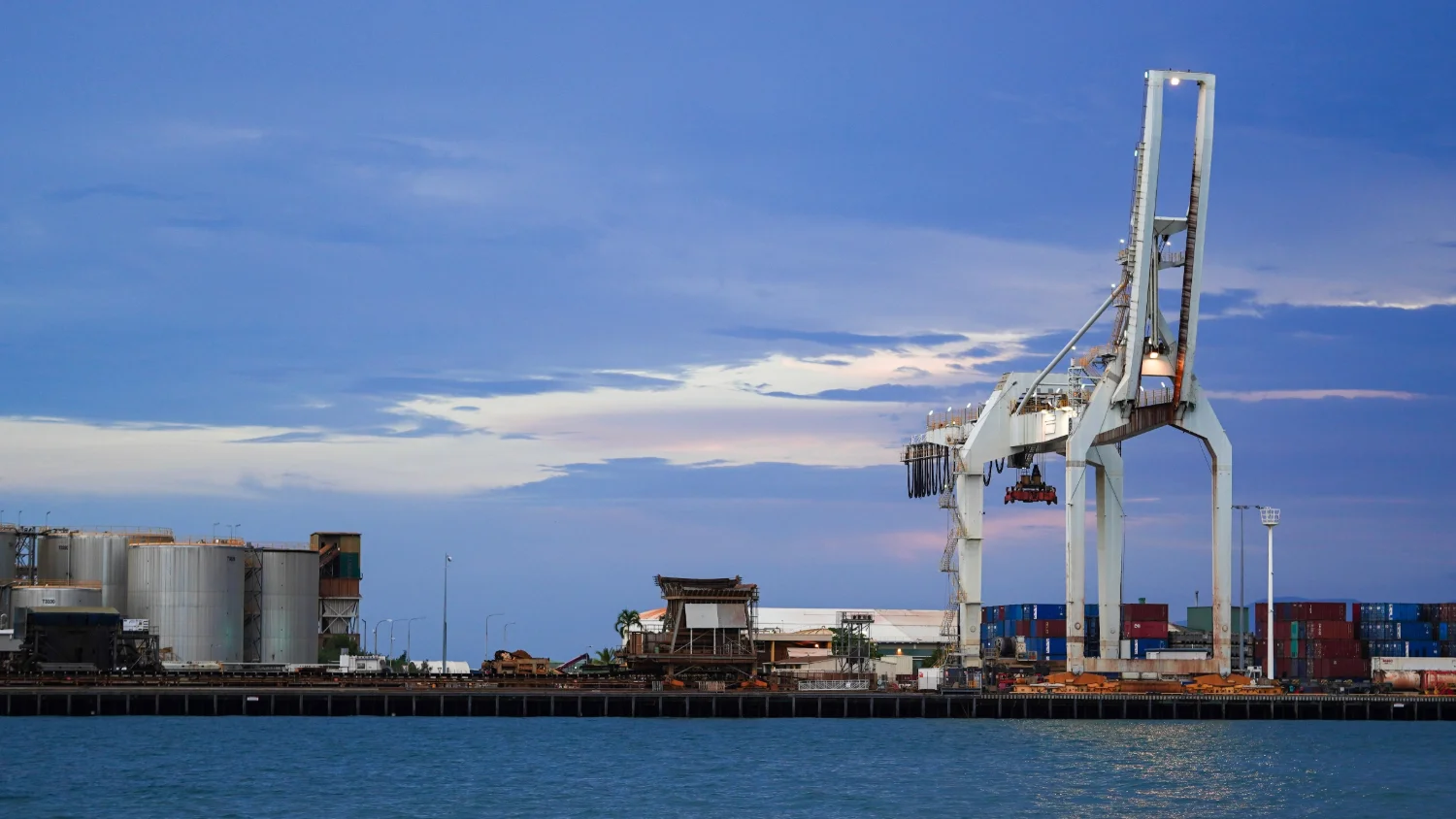
The problem: the list is valuable, but nobody sells it
Southern Tamaulipas is one of Mexico's most important industrial export zones. The Industrial Port of Altamira has a land reserve of about 9,500 hectares, and industrial park directories list more than 90 companies in the port area, among them BASF, SABIC, Chemours and POSCO. The port ranks first in Mexico for petrochemical fluids, with more than 3.2 million tons handled in 2023. Much of the petrochemical and plastics output of the corridor goes to or through the US Gulf Coast, which is exactly the lane a Houston forwarder serves.
The industrial port in numbers
Source: Wikipedia (Altamira Municipality) / ProMexico Industry.
Source: ProMexico Industry park directory.
Source: ASIPONA Altamira, statistical closure 2023.
So why is the list hard to build?
- No public exporter registry with contacts. Mexican customs data identifies exporters at an aggregate level. Commercial trade-data platforms show shipments, but often only for ocean cargo, often under a parent or a customs broker's name, and rarely with a named logistics contact.
- Listbrokers are thin on regional Mexican mid-market firms. Large names (BASF, DuPont-legacy plants, synthetic rubber producers) appear everywhere. The 30 to 300 employee plastics compounder, the steel fabricator in Tampico or the agro-processor in Altamira usually do not, or appear with outdated data.
- The decision-maker is hidden. Websites list a general contacto email. The export manager is found on a careers page, in a press release, in a trade-show exhibitor list or on a public LinkedIn profile, rarely in one place.
- Bilingual noise. Some sites are Spanish only, some English only, some name the role "Comercio Exterior", others "Supply Chain" or "Tráfico".
- Manual effort. Checking one company properly (does it export? to the US? who runs logistics?) takes 10 to 20 minutes of browsing. For several hundred companies in the region that is multiple weeks of research time, before a single sales call.
How Haystack helps
Haystack combines a Google Maps search across the whole region with an AI that visits each company's website and runs targeted web searches. It works in stages: filter cheaply first, research in depth only for companies that qualify.
Realistically, setup and a test run take an afternoon. After that, Haystack processes the whole region automatically, and your team only reviews the qualified companies. Expect gaps: not every exporter publishes who runs logistics. We mark those as "not found" rather than guessing.
For an overview of all examples, see AI-built lead lists: real-world examples.

How Haystack finds the data, step by step
1. Collect every business in the region
It starts with a Google Maps search that covers the whole region square by square: Altamira with its industrial port and industrial parks, Tampico, Ciudad Madero and the corridor along the highway toward Tampico. Because local businesses are listed in Spanish, Haystack searches with Spanish and English terms, for example:
- fábrica, planta industrial, manufacturera
- empresa petroquímica, plásticos, química
- exportadora, comercializadora internacional
- acero, estructuras metálicas, maquinados
- empacadora, alimentos procesados
- manufacturer, chemical plant
Why Google Maps? Nearly every plant has a listing there with address, phone, website and category.
2. Check in stages
The order follows a simple principle: filter cheaply first, then research in depth. The table shows what happens in each stage and why.
The stages at a glance
| Stage | What happens | Why |
|---|---|---|
| Stage 1: Spot shippers | Haystack checks name and Google category to see whether the business is a manufacturer or exporter. | A business that makes or ships nothing has no use for a forwarder. |
| Stage 2: Confirm US exports | Haystack reads website pages such as "Nosotros", "Exportación", "Mercados" or "Certificaciones" and searches the web for US customers, US certifications or USMCA (T-MEC) references. Result: yes, likely or no, each with evidence. | This is the core question. Only companies shipping to the US matter to a Houston forwarder. |
| Stage 2: Capture products | Haystack notes what the company ships: bulk liquids, resins in bags, steel parts or perishables. | Sales can tailor the pitch to the actual freight. |
| Stage 3: Find the contact | Haystack searches team, contact and news pages plus public search results (such as LinkedIn) for the export or logistics manager at the Mexican site, or the plant manager as a fallback, always with the source. | This research is costly and only pays off for confirmed US exporters. |
| Stage 3: Estimate the shipping mode | Haystack reads clues such as product type, port and terminal mentions, rail spurs, tank farms or logistics partners: truck through Laredo, ocean through Altamira, rail or bulk liquid. | Sales knows which service fits before the first call. |
| Stage 4: Score the leads | Each company gets a score from 1 to 10 with a short reason. | Sales starts with the most promising leads instead of the alphabet. |
Proven checks can be reused for other regions such as Monterrey, Saltillo or the Bajío. The same staged approach works on the other side of the border too, for example for Fort Worth warehouses hiring forklift operators.
Test run and spot check
Before the whole region runs, Haystack checks a small sample of about 30 companies to see where answers are missing or off. Typical corrections, then the full set runs:
- 01
Many companies without export evidence
Many small plants have thin websites. Haystack then also searches for terms like "T-MEC" or "Norteamérica", and companies marked "likely" get a quick check by sales.
- 02
Contacts from the wrong country
With multinationals, people from a branch abroad show up easily. Haystack therefore only keeps people who work for the Mexican operation.
- 03
Customs brokers in the list
Customs brokers (agencia aduanal) are not shippers and are explicitly filtered out in stage 1.
3. What you end up with
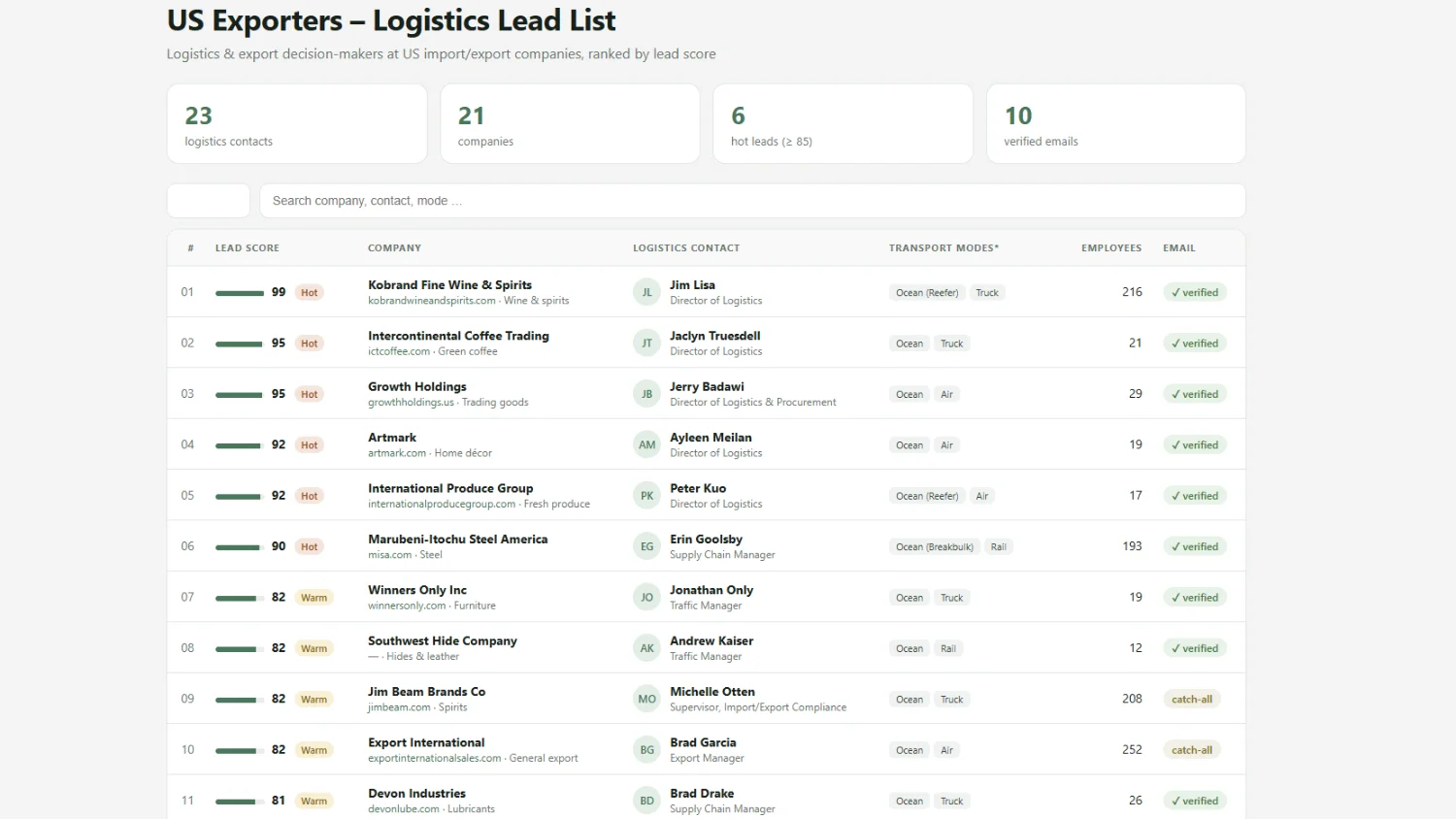
You receive a list of every company with confirmed or likely US exports, sorted by score. For each company you see name, address, phone, website, products, shipping mode, contact and the source for each piece of information. Companies with several plants appear once.
On request, there is also an overview of every company checked, with the reason it is not on the list. That answers "why is company X missing?" right away.
It is delivered as a password-protected link and an Excel file that the forwarder's CRM team can import directly.
Honest limits
- Coverage depends on Google Maps. Plants inside the port area that are not listed on Maps, or listed only under a parent company's name, can be missed. Complement with the port's own tenant list if you need full coverage.
- Export evidence is what companies publish. A company can export to the US without saying so online. Those end up as "not found", not "no".
- Contact names are not guaranteed. In our experience, named export or logistics managers are found for a portion of the qualified companies, not all; large multinationals often hide them, and people change jobs. Treat each name as a lead to verify, not as a confirmed fact.
- No emails or phone numbers of individuals are invented. Haystack shows what public sources show. It does not send emails, sync to a CRM or access LinkedIn through an API; LinkedIn profiles only appear as public web search results.
More examples: the same idea, a cheap filter first and in-depth research later, is used for IT staffing agencies in Central New Jersey and for Toronto D2C fashion brands on Shopify.
Data protection
Personal data of business contacts in Mexico falls under Mexico's federal personal data protection law (LFPDPPP; a new version entered into force in 2025). Use names and job titles only for legitimate B2B outreach, keep a record of the source, and honor opt-out requests (ARCO rights). If you email prospects from the US, CAN-SPAM applies: accurate sender information, a clear subject, a physical address and a working unsubscribe. Calling Mexican business numbers is not subject to US telemarketing rules in the same way as US consumers, but check REPEP (Mexico's do-not-call registry) for any consumer numbers.
More real-world examples
Fort Worth Warehouses Hiring Forklift Operators: Building a Lead List with Plant Manager Names
How a Texas guardrail maker finds every Fort Worth warehouse and plant with active forklift hiring, plus the plant or facility manager's name.
How to Find Every IT Staffing Agency in Central NJ With Open C2C Java or SAP Roles (and the Owner's LinkedIn)
Build a verified list of Central New Jersey IT staffing agencies with open C2C Java or SAP contracts, plus owner LinkedIn profiles, using Haystack.
Moving Companies in NRW Without Google Ads: Lead List with Owner and Direct Line
How a Google Ads agency builds a list of every moving company in NRW with 100+ reviews, no ads, plus owner and direct line from the Impressum.
FAQ
Can Haystack tell me how many containers a company ships?
No. Haystack does not include customs or shipment data. It finds public evidence that a company exports to the US and how it likely ships. For volumes, combine the list with a trade-data provider.
Why use Google Maps and not a company database?
Because regional Mexican manufacturers are often missing or outdated in international databases, while most plants have a Google Maps listing with a website. Haystack has no company database of its own; it builds the list fresh from Maps and the web.
Does it work for Spanish-only websites?
Yes. Haystack reads Spanish pages and searches with Spanish job titles and search phrases. Results are returned in English.
How fresh is the data?
As fresh as the run. Have the same region checked again every few months to catch new plants and job changes.
Can I extend this to Monterrey, Saltillo or Reynosa?
Yes. The same checks simply run over a different search area.
Sources
- ASIPONA Altamira: Port of Altamira Yearbook 2026 — Puerto de Altamira, 2026
- ASIPONA Altamira: Statistical closure 2023 — Puerto de Altamira, 2023
- Altamira Municipality, Tamaulipas (Wikipedia) — Wikipedia
- ProMexico Industry: Puerto Industrial Altamira — ProMéxico Industry
- US FTC: CAN-SPAM Act compliance guide — Federal Trade Commission
Get your list
If you sell freight, customs or warehousing services on the lane between Mexico and the US, we build this list for you: Altamira/Tampico or any other Mexican industrial region, delivered as a password-protected link and Excel file. Contact Haystack with your target region and ideal shipper profile.
Request data